Category 1, 2 & 3 Water Damage: What Little Elm Homeowners Need to Know
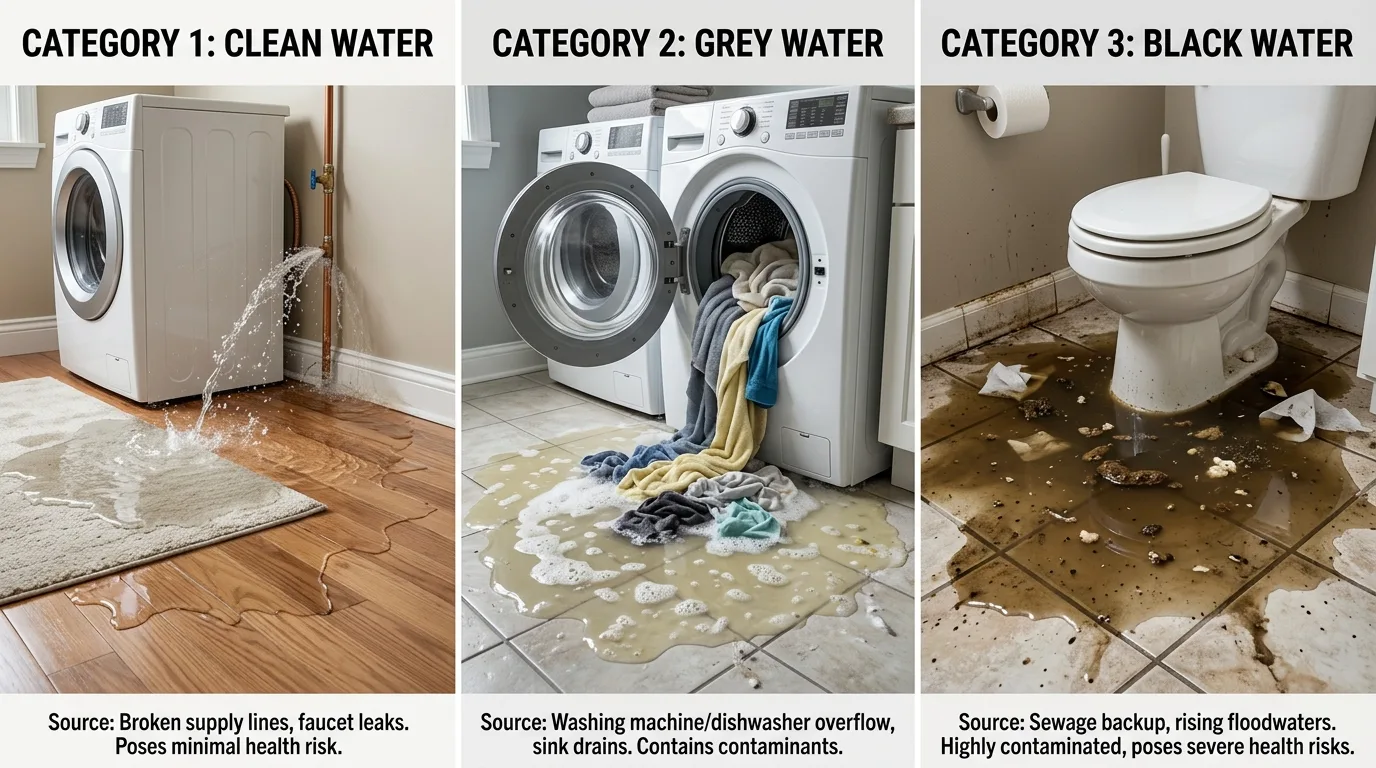
When a restoration contractor tells you that your Little Elm home has “Category 2 water damage,” many homeowners aren’t sure what that means — or why it matters. Water damage categories aren’t just industry jargon: they determine how the cleanup is performed, which materials must be removed vs. dried in place, what PPE the crew wears, and ultimately how much your project will cost. This guide explains what the IICRC water damage category system means in practical terms for Little Elm homeowners.
In this post, we cover how the three water categories are defined, what each means for cleanup protocols and cost in Little Elm, how categories change over time if cleanup is delayed, and the most common sources of each category in Denton County homes.
Water Damage in Your Little Elm Home? We'll Assess the Category Immediately.
IICRC-certified assessment and restoration for all water categories. Call (877) 698-1311.
Why Water Damage Categories Matter in Little Elm
The IICRC (Institute of Inspection, Cleaning and Restoration Certification) S500 Standard established the three-category water classification system used industry-wide. The categories reflect the level of contamination in the water at the time of impact and drive the entire restoration approach. In Little Elm, the distribution of water damage events across categories reflects the region’s specific risk profile: spring storm season produces a disproportionate share of Category 3 events (outdoor flooding), while slab-leak events and appliance failures typically start as Category 1 or 2 but can escalate to Category 3 if left unresolved for extended periods.
Understanding your water’s category before any work begins is essential because it determines whether your contractor should be attempting to dry materials in place or removing them — one of the most consequential decisions in a restoration project.
Category 1: Clean Water — $3–$8 Per Square Foot
Category 1 water originates from a sanitary source and contains no substantial contamination at the time of impact. In Little Elm homes, the most common Category 1 sources are:
- Supply line breaks: A copper or PEX supply line under the slab, inside a wall, or at an appliance connection has ruptured. The water released is from the pressurized supply system — clean, treated municipal water.
- Toilet tank overflow: The toilet tank (not bowl) overflows or a fill valve malfunctions. The tank water is clean supply water.
- Water heater supply line failure: The cold-water supply line to the water heater ruptures.
- Rainwater through a clean roof leak: Rainwater that enters through a newly failed roof penetration without soil contact.
Category 1 cleanup allows for the possibility of in-place drying — if the response is fast enough (within 24 hours in Little Elm’s climate) and moisture readings confirm materials haven’t exceeded IICRC thresholds. This is the best-case scenario: extraction, drying equipment placement, and daily moisture monitoring without demolition or material replacement in many cases. Cost: $3–$8/sq ft.
Category 2: Gray Water — $4–$12 Per Square Foot
Category 2 water has significant contamination that could cause illness if ingested. It doesn’t contain solid waste or pathogenic material, but it contains chemical, biological, or physical agents at levels that require decontamination treatment before materials can be safely retained or dried in place. In Little Elm homes, common Category 2 sources include:
- Washing machine discharge overflow: The machine’s drain hose has backed up or disconnected, releasing gray water.
- Toilet bowl overflow without solids: A toilet has overflowed from the bowl (not tank) but contained no solid waste.
- Sump pump failure during rainfall: The sump system has failed during a rainfall event, allowing groundwater that has passed through the sump to enter the space.
- Dishwasher overflow: Discharge water from the dishwasher’s drain system.
- HVAC condensate overflow: Air handler condensate that has overflowed the drain pan (North Texas AC condensate has low contamination but technically classifies as Category 2 in most protocols).
Category 2 cleanup requires decontamination of all surfaces contacted by the water. Some porous materials — depending on the contact time, the specific contaminants, and material porosity — may need to be removed rather than dried in place. Carpet with padding in Category 2 contact is typically removed; hardwood may be salvageable with rapid response and treatment. Cost: $4–$12/sq ft.
Know Your Water Category? Get a Full Restoration Quote for Little Elm
We assess water categories on-site and provide immediate restoration plans for all Denton County homeowners. Call (877) 698-1311.
Category 3: Black Water — $7–$20+ Per Square Foot
Category 3 water is grossly contaminated and contains pathogenic agents — bacteria, viruses, and chemical contaminants that pose serious health risks with direct contact and potentially with proximity to contaminated materials. In Little Elm, Category 3 sources include:
- Sewage backup: Any toilet overflow with solids present, sewer line backup surfacing at drain openings, or septic system overflow.
- Outdoor flooding with soil contact: Any water that has been in contact with outdoor soil, including storm flooding from rain, Lewisville Lake overflow, Trinity River tributary flooding, and any other external water intrusion.
- Category 1 or 2 water that has been standing for more than 48 hours: Clean water that wasn’t extracted quickly and has been standing long enough to develop biological contamination from contact with flooring, framing, and other organic materials is reclassified as Category 3.
Category 3 requires full biohazard protocols: PPE for technicians, air scrubbers and containment to prevent spread, complete removal of all porous materials below the affected line (carpet, padding, drywall, insulation, unsealed hardwood), EPA-registered antimicrobial treatment of all remaining hard surfaces, and post-treatment air quality testing before reconstruction. Cost: $7–$20+/sq ft. This is the most expensive category — and the one most commonly associated with Little Elm spring storm events and sewage backup events.
How Water Categories Change Over Time
A critically important concept that many homeowners miss: water damage categories can escalate over time. Category 1 water that is extracted and dried within 24 hours may remain Category 1 throughout the project. The same Category 1 water left standing for 48+ hours in Little Elm’s warm climate — in contact with drywall paper, wood framing, and other organic materials — is reclassified as Category 3. The materials have become contaminated by the biological activity that begins in standing water.
This reclassification is why delayed response to water damage is so costly. A homeowner who decides to “wait and see” after a burst pipe, confident that the water looks clean, may return after 48–72 hours to find their contractor recommending Category 3 protocols — with material replacement and full decontamination requirements — for what appeared to be a Category 1 event. The additional cost difference between Category 1 and Category 3 restoration on a 400-square-foot affected area in Little Elm is typically $3,000–$7,000 or more.
What Category Determines in an Insurance Claim
Water category documentation is important for insurance claim processing in Texas. The claim estimate from your insurer should reflect the appropriate protocols for the assessed category. A Category 3 estimate that is written as if it were Category 1 (allowing for in-place drying) may not cover the actual material replacement required and will produce a dispute when the contractor’s scope exceeds the insurer’s estimate.
Our documentation packages include the water category classification, the basis for the classification (water source, contamination testing if performed, timeline of contact), and the specific protocols applied for that category — information that supports clear, complete insurance claim restoration settlements without back-and-forth over scope disputes.
Frequently Asked Questions About Water Damage Categories in Little Elm
Can Category 2 water damage be dried without removing materials in Little Elm?
Possibly, with fast response and appropriate conditions. Category 2 gray water in contact with hardwood flooring for less than 24 hours, with rapid extraction followed by immediate dehumidification, can sometimes be managed without floor replacement — but this assessment requires professional moisture meter evaluation, not visual judgment. Carpet and padding in Category 2 contact are almost always replaced rather than dried. In Little Elm’s warm climate, the assessment must happen within hours of discovery.
Does outdoor flooding always classify as Category 3 in Little Elm?
Yes — any water that has been in contact with outdoor soil is automatically Category 3 regardless of its original source. This applies to Lewisville Lake overflow, Trinity River tributary flooding, stormwater drainage backup, and direct rainfall entry through foundation cracks. Even if the water looks clear, contact with soil introduces pathogenic contamination at levels requiring full Category 3 protocols.
How does water category affect my insurance claim in Texas?
The insurer’s estimate should reflect the restoration scope required for the assessed category. Category 3 estimates appropriately include material replacement costs, PPE and disposal costs, and decontamination treatment costs that don’t appear in Category 1 estimates. If your insurer’s estimate doesn’t reflect these category-appropriate costs, request a supplemental review supported by your contractor’s scope of work and the category classification documentation.
IICRC-Certified Category Assessment for Your Little Elm Home
Correct category classification determines your entire restoration approach. Call (877) 698-1311 for a professional on-site assessment.
Related: