Same-Day Water Extraction in Little Elm: Our 8-Step Restoration Process
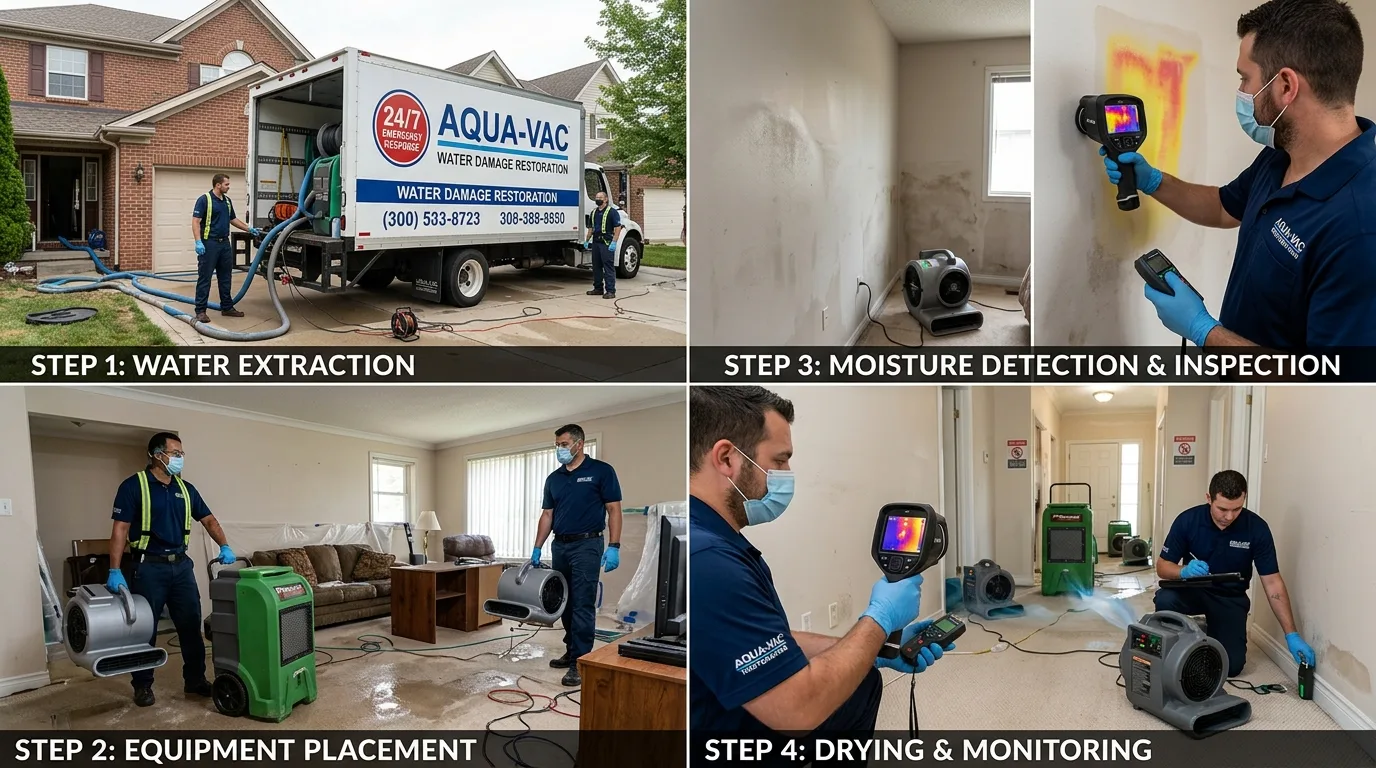
When you call us about water damage in your Little Elm home, you’re not just getting water removed — you’re getting a systematic, documented restoration process that returns your home to pre-loss condition. Most homeowners have never seen the inside of a professional water damage restoration before, and knowing what’s happening at each phase reduces stress during an already difficult situation. This guide walks through our complete 8-step process, with specific notes on how each step applies to Denton County homes and conditions.
In this post, we cover all 8 phases of water damage restoration, why each step is performed in this specific order, what you should expect to see at each phase, and the timeline for a typical Little Elm restoration project.
Water Damage Happening Now? Step 1 Starts With Your Call.
24/7 emergency response for Little Elm and all of Denton County. Call (877) 698-1311.
Why Process Order Matters in Water Damage Restoration
Water damage restoration is not simply “cleaning up” — it’s a systematic process where each step creates the conditions for the next to succeed. Performing steps out of order produces failures: drying without extracting first is ineffective; rebuilding before materials are confirmed dry produces mold; reconstructing before permits are obtained produces violations. The 8-step process below is derived from IICRC S500 standards and is the correct sequence for residential water damage restoration in Little Elm’s climate.
Step 1: Emergency Call and Dispatch
Water damage restoration in Little Elm begins the moment you call. Our emergency line is answered 24 hours a day, 7 days a week — including spring storm season when multiple events may be occurring simultaneously across Denton County. During the initial call, we assess the situation to determine equipment needs, crew size, and response priority. We confirm the water source (burst pipe, appliance failure, storm flooding) to deploy the appropriate equipment — a sewage backup requires different PPE and disposal equipment than a supply line break.
Response time to Little Elm is typically under 60 minutes from the initial call. The faster we arrive, the less Category 1 water has time to escalate toward contaminated status, and the smaller the final restoration scope.
Step 2: Thermal Imaging Inspection and Moisture Mapping
Before any water is touched, our technicians perform a comprehensive inspection using thermal imaging cameras and calibrated moisture meters. Thermal imaging identifies moisture inside wall cavities, under flooring, and above ceilings that isn’t visible from the room surface — and in most Little Elm water damage events, the hidden moisture far exceeds the visible water. The moisture mapping documents every affected area with readings, creating the before-documentation required for insurance claims.
This step determines the full scope of the restoration project. Skipping it — jumping straight to extraction — leads to the most common restoration mistake: drying only what’s visible while concealed moisture continues to cause damage and feed mold. In homes throughout Paloma Creek and Union Park with complex wall assemblies and interior framing, thermal imaging is especially important because wall cavity moisture pathways are non-obvious.
Step 3: Water Extraction
With the scope defined, bulk water extraction begins using truck-mounted extractors and portable units. Truck-mounted equipment is the most powerful available — capable of removing thousands of gallons per hour from flooded spaces. After bulk water is removed, specialty extraction tools address moisture in carpet, carpet padding, and flooring assemblies that simple mopping cannot reach.
For Category 3 events (sewage backup, outdoor flooding), full PPE protocols are established before extraction begins. The extraction waste stream from Category 3 events is handled as contaminated material requiring proper disposal — not simply pumped to a storm drain.
Experiencing Water Damage Right Now? Skip to Step 1.
Our 24/7 emergency team is ready to begin the restoration process for your Little Elm home. Call (877) 698-1311.
Step 4: Material Assessment and Removal
After extraction, the moisture mapping data determines which materials can be dried in place and which must be removed. For Category 1 events with fast response, many materials can be dried in place — preserving flooring, drywall, and framing without demolition. For Category 2 and 3 events, or any event where materials exceeded moisture thresholds during the response delay, affected porous materials are removed: carpet, padding, drywall, insulation, and contaminated flooring.
Material removal in Little Elm projects requires permits for structural demolition — the Town of Little Elm’s MyGov system. We coordinate permit applications to run in parallel with extraction and drying, so permits are obtained before reconstruction begins but the drying phase is not delayed by permit processing.
Step 5: Structural Drying with Industrial Equipment
Industrial dehumidifiers and high-velocity air movers are strategically placed throughout the affected area based on the moisture map from Step 2. This is not random equipment placement — the drying plan specifies equipment type, quantity, and placement positions calculated to achieve the targeted psychrometric conditions for effective drying in Little Elm’s specific climate.
Daily moisture readings track progress at each documented measurement point. The drying phase continues until all materials reach the target moisture content established by IICRC standards — typically 3–7 days for typical residential events in Denton County. Equipment is not removed on a fixed-day schedule; it’s removed when measurements confirm the drying objective is achieved. This distinction is the difference between a properly completed restoration and one that leaves hidden moisture behind.
Step 6: Mold Prevention and Antimicrobial Treatment
Before reconstruction begins, all surfaces that contacted water receive EPA-registered antimicrobial treatment appropriate to the water category. For Category 1 events with rapid response, this is a standard antimicrobial application. For Category 2 and 3 events, the treatment protocol is more intensive — including HEPA vacuuming of structural surfaces and the application of EPA-registered antimicrobials specifically rated for pathogenic organisms.
For any project where the drying phase extended beyond 48 hours, or where structural materials were above moisture thresholds for an extended period, a mold assessment is performed before reconstruction to confirm no colonization established during the water event. This step prevents the scenario where a restored room develops a mold smell within weeks of reconstruction because undetected mold was sealed inside a wall cavity.
Step 7: Reconstruction and Repairs
After drying is confirmed and antimicrobial treatment is complete, reconstruction begins — replacing the materials removed in Step 4 and repairing any structural damage identified during the water event. Drywall installation, insulation replacement, flooring installation, and trim work are performed by experienced reconstruction crews. Plumbing repairs (if the water event originated from a pipe failure) are performed by licensed plumbers and inspected by Little Elm’s building department.
Insurance claim restoration documentation continues through this phase — change orders, supplemental documentation, and material specifications are provided to the carrier as reconstruction scope is finalized. Our goal is to close out the insurance claim with all approved supplements before the final walkthrough.
Step 8: Final Inspection and Project Closeout
The final phase includes a post-restoration moisture verification — confirming that all materials are within acceptable moisture ranges after reconstruction is complete — and a final walkthrough with the homeowner. Any reconstruction items that don’t meet quality standards are addressed before closeout. The complete documentation package — moisture logs, before/after photos, equipment records, permit close-out, and final inspection report — is provided to the homeowner for their records and insurance file.
For Little Elm homeowners who plan to sell within the next few years, this documentation package provides the disclosure record that real estate law requires — a professionally documented restoration history that demonstrates the event was properly addressed to IICRC standards.
Frequently Asked Questions About Our Restoration Process in Little Elm
How long does the full 8-step process take for a typical Little Elm water damage event?
A single-room Category 1 event with fast response (Steps 1–8): 5–10 days total. A multi-room Category 2 event with moderate scope: 10–21 days. A Category 3 event or a slab-leak event with structural involvement: 3–6 weeks. The drying phase (Step 5) is the time variable — it cannot be rushed without risking hidden moisture in the completed restoration.
Can I stay in my Little Elm home during the restoration process?
For most events, yes. The extraction and early drying phases produce significant equipment noise and some disruption, but the home remains habitable for most of the project. Exceptions include Category 3 events where contaminated areas must be fully contained and inaccessible during decontamination. We discuss habitability specifically at the initial assessment and help coordinate temporary accommodations when needed.
Do you handle all 8 steps, or do I need separate contractors?
We manage all phases of restoration from extraction through reconstruction as a single-contractor project. This eliminates handoff gaps between extraction and drying, or between drying and reconstruction, that create timeline delays and moisture management failures when multiple contractors are involved. One point of contact, one timeline, one documentation package for your insurance claim.
Experience the Full 8-Step Restoration Process in Little Elm
From same-day emergency extraction through final reconstruction. Call (877) 698-1311 for IICRC-certified restoration across Little Elm and Denton County.
Related: